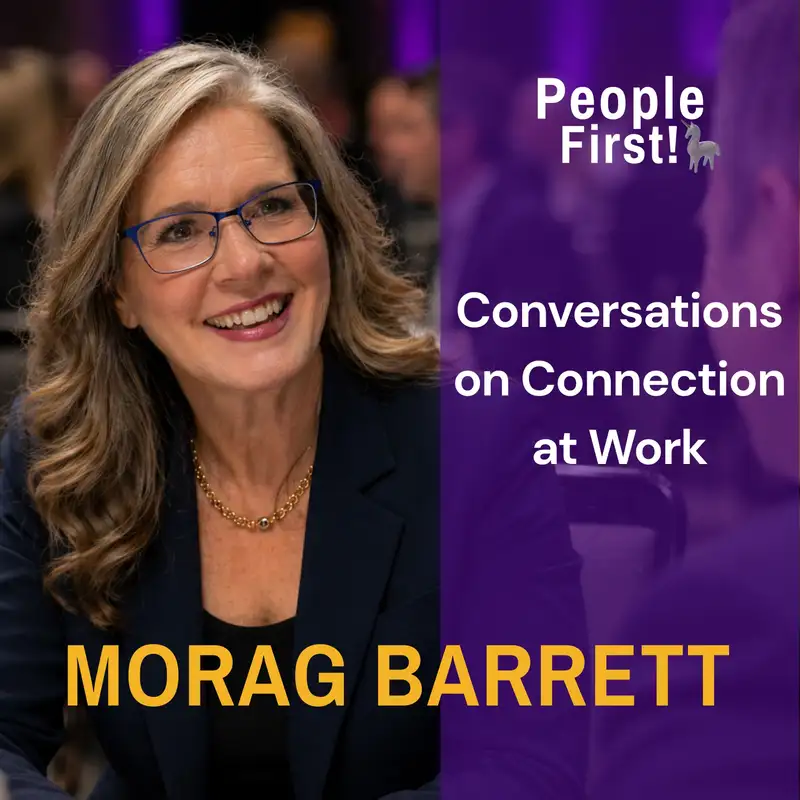
The Psychology of Connection at Work: The Science Behind Connection, and What Leaders Can Do About It Today Dr. Bobbi Wegner
Download MP3Welcome to this week's episode of People First. And I'm excited to introduce to you my guest this week, who is Dr. Bobbi Wegner. Bobbi is a psychologist, a lecturer at Harvard in industrial organizational psychology. She's an author, a speaker, and an advisor focused on helping teams feel and function their best. After fourteen years of practicing psychology while teaching courses at Harvard on groups and culture, motivation and coaching, she saw an opportunity to serve more people in organizations everywhere so that we can all feel and live better by working better together. Groups brings experts in group psychology to organizations to engage employees in practice-based programs designed to improve working relationships, which improves personal and professional outcomes. She's building towards being the global hub of workplace connection, and we're just getting started. Well, you can probably hear from that introduction, for those of you who regularly check into People First, why I am so excited for this conversation. Let's just summarize. Hashtag better together. Focused on building cultures of connection in a world that is increasingly disconnected and a focus and passion for how work happens and the relationships that make or break teams every single day. So, Bobby, welcome to People First. Thanks, Morag. I'm super excited to be here and can't wait to have this conversation. I know. And we were just checking in the green room. I mean, our whole coming together today is another example of just how small the world is and two degrees of connection, because I actually was listening into a conversation that you had with another mutual colleague of ours and then reached out with a big, please come on people first. So thank you for accepting that invitation. Of course. We have a lot of shared interests, so this will be fun. So let's start though with your relationship question. So outside of family, I'm curious, who comes to mind as somebody who's had a direct impact on who you are and how you got to where you are today? Yeah. So aside from family, it's really Dr. Lee. So he was my professor. I went to Trinity College in Hartford, Connecticut, and it was about my junior year of college. And, you know, I knew a bit about psychology. You know, I had majored in it and I was learning it. but I had not heard of clinical health psychology yet. I'm the youngest of five kids. My oldest sister had developmental disabilities, was pretty impaired, impacted. So health was always a part of just like my family and growing up. And Amy was my... and my roommate until I was about sixteen. And I sort of found myself in this health psychology class and realized it was like the first time I really started to think about mind body connection and impact on health and functioning and families and like the whole thing. And Dr. Lee was the professor of that class. So he was just the coolest guy. He is just the coolest guy. He's still at Trinity College. And it really just ignited this curiosity and passion in me. And from there, I was like, I know this is what I want to do. I want to be like Dr. Lee. You know, I end up graduating Trinity college. And going on into New York and working at Memorial Sloan Kettering Cancer Center, doing clinical trials research in advanced cancer, ended up getting my doctorate in clinical psychology with a specialization in health psychology. And that really meant working with medical populations, but then also like stress management. A lot of that's mindset and changing the way you're thinking and breathing. And through that work, I ended up working with executives and teams. And that really drew me into the work psych world. But I really started with Dr. Lee and, you know, kind of showing me what clinical health psychology is. And that really put me on this journey that I've been on now for however many years, twenty something years. Yeah. Twenty close to twenty five years. Time flies when you're having fun, doesn't it? Well, I'm going to leave you with this challenge, request, invitation, and it may be something that you're doing naturally anyway, but for everybody listening too, as you listen to Bobby describe Dr. Lee and the impact that that he'd had on her and her career I'm sure that people came to mind for each of you who've made a difference for you so bobby I challenge you send a note to dr lee after this conversation just to remind him of the ongoing ripple effect that he's having and the same for those listening reach out acknowledge the contribution you're going to make somebody's day when you do it so You're busy here at Harvard. You have your whole life. And yet there's also time and space here for groups. And for those who are listening to the audio recording, groups is spelt G-R-O-O-P-S. So tell us about groups. What was the inspiration for that platform and the work you're doing there? Yeah. Yeah. So it's interesting. So it's funny kind of where our conversation starting. People see clinical psychology and organizational psychology as sort of two different things, but they're really not like it's like human behavior is human behavior and it's contextualized and shows up in different spaces. Everything I've always done has been focused on relationships because as humans who are hardwired for connection, social by nature. When we can get our relational dynamics right, it improves outcomes on the health front, but also the organizational side, too. So anyway, I had been working in a behavioral medicine practice for thirteen or fourteen years. I started teaching at Harvard about eight years ago and started off teaching in the School of Education, and they were building out the organizational psychology program about five years ago. It's still pretty young there. And I ended up hopping over to the Division of Professional Education and helping build out some of their core courses because I was already working with organizations and with leaders. And so we put together my first class, which was motivation, what drives human behavior in the workplace and global, you know, virtual class. And we log on to the first class and there's two hundred and fifty people there. you know, all people who are working full time and then upskilling in organizational psychology. I just realized there's this huge need that people are really trying to figure out how they can learn more about psychology to be better leaders, to lead better teams, to build stronger culture. And a lot of these people are really coming at it from a business perspective, not a psychology perspective. And also they don't have the ability to really scale themselves. So I said, oh, we can help solve this problem. Let's build a platform that brings people with like psychologists, people with masters and doctorates, upskill them in org psych and then sell low cost subscriptions to their services on an ongoing basis and build a platform that looks at the de-identified notes of the facilitator and employee surveys. And then we can look at sort of correlations between connection and performance and give insight back. So we basically saw a need. I saw a solution and just kind of put the two things together and off we went. So tell me a little bit about the research that you've done. I mean, you've touched on there about the power of our relationships. It's the interpersonal dynamics that for leaders who are working in the workplace, there is that there's a hesitation with a clinical psychologist and that, oh, you're going to analyze me. In the research that you've done, just to start with the basics, why should leaders care about the health of the relationships that they're creating or the health of the relationship amongst their team? Yeah. Yeah. I know people get like kind of freaked out when you put a clinic. If you think about clinical psychology, you're like, oh, my God, you're going to diagnose me with something like the thing here. But psychologists are really relationship experts. You know, they're really good at looking at dynamics and like trying to figure out how to optimize them to help people like feel and function their best work is no different. Right. So we're all we do when we go in is really help get very clear around the shared goals of the team. Right. That's like we know from group psychology when there's a very clear kind of shared goals, there's going to be increased alignment that goes into building a high cohesion, high performing team. Instead of thinking of it as like psychology, mental health, think of it as like cohesion, which is effectively the professional word for connection. And we know when you have high levels of cohesion, it's correlated with high levels of performance. It's teams with high levels of cohesion are twenty one percent more profitable, have fifty nine percent better retention. We also know it's probably the biggest driver of our Surgeon General right now is sort of disconnection. Right. Knowing that that can be more deadly than, you know, heart disease and different different diseases. Knowing that it's like disconnection and isolation is more deadly than smoking fifteen cigarettes a day. It's like we're not really going after isolation per se, but the other side of the coin is really when you can bring people together and optimize the relationships, everybody wins, including the businesses. And it saves the company money. It does. And it's common sense. I mean, you and I are speaking a similar language and yet time and time again, it's an uncommon discipline. So what is it that gets in the way of leaders embracing this concept more wholeheartedly? Yeah. What's the gets in the way? I mean, I think a lot of people don't know psychology, I always say is not rocket science, but it's like, you know, and once you see it, it's like seeing the matrix. So a lot of it's just having to teach people about like, what we're even solving for people don't really know. you know what the impact can be until you do a little bit of education. Like what you know, we're not just going in and sort of diagnosing problems or something. It's like we're actually there's a science behind how you bring people together to optimize relationships. But like the everyday person, the everyday leader probably doesn't really totally get that. They know that when their teams are working well, like everything's better, but they don't understand like how to get there. And they know when it's not because they go home and they're complaining to whomever or walking out of the home office and complaining about, oh, you won't believe what happened at work today. So you said there's a science for how we bring people together. And obviously the pandemic did a real doozy on our ability to bring people together. And it's continuing to cast that influence with the increased remote working. I mean, our relationship is through the camera too. So what best practices, what tips do you have for people in how to bring folks together, whether it's in three dimensions or in two dimensions? Mm-hmm. I mean, you really have to think about work relationships as any relationship, right? It's like we think of like when you go to work that it's, you know, people want to be directed or just told what to do. And but that's not really the case. And we know that's definitely not the case, especially as younger generations are coming up. COVID in a lot of ways has reset everything for us because we're living in this virtual world and we need to bring people together in a much more intentional way because we don't have those natural touch points you might have in the office for many companies. Many companies have at least some form of hybrid work. So just the days of everybody showing up to work every single day are gone. Yeah. So what we really need to do is like create intentional time to deepen connection and improve relationships in the workplace. Right. And just put some structure around this to allow people to get those social needs met. You know, this really comes back to the idea that we're, um, we're social animals and we need connection like we need water and like we need air and the virtual world has stripped us of that. So now companies have to think differently about how you bring people together. to talk about things that are beyond work, just to build the relationship, if for no other purpose, so people can feel more connected and not leave at the very least, which costs companies a lot of money. Yeah, I mean, Gallup just came out with their twenty twenty five state of the workplace report, and it shows we're a ten year low for engagement results. So the needle is definitely moving in the wrong direction. So what's one thing that leaders can do to use psychology based coaching to build those stronger teams and relationships that we may all want? Yeah. So one thing we do, we teach on is a framework. It comes out of the motivational interviewing kind of world, which is not interviewing at all. It's a coaching. It's a coaching modality, but it's asking questions. You know, leaders think that they're just supposed to, not all leaders. Well, great leaders don't do this. But like, how do you ask more questions to help people solve their own problems? Really starting with, okay, what is the problem? And then asking what or how questions, just keep peeling back the problem and let the person they're leading really solve their own problems. Through that experience too, the, you know, ORS is a framework through motivational interviewing. It's asking open-ended questions, making affirmations, which is sort of like empathizing and validating. I can see how you would think that way, even if you don't agree with the behavior, making reflective statements back, just literally saying back what the persons shared and then summarizing the conversation. I think people would be surprised to see. how helpful that can be just using that simple framework where people can kind of come to their own solutions. But part of it is also just building a relationship. People feel like you really care and you're investing when you're sitting there and you're listening and you're reflecting. It shows that you're really like in it with them in a deeper way. So how do you counter then the leaders that say, I'm too busy for this? This is a workplace. Just get your stuff done. Yeah. Well, I would say what's your retention, how, how high are you turning right now? Um, because you know, and I would also say there's a time and place for everything. So a lot of, we do get this, this question all the time. We just, I was just, I teach a groups and culture class, which is effectively a team psychology class, literally just got a class a few minutes ago. And we were talking just about this, which is like, how do you do this in a time constrained world? And the thing is like, people wanna feel like they belong. Like, come back to this idea that we need each other. We need connection. And people are also, generally speaking, rational humans. So you can say, you know, hey, I've got two minutes. I don't have a lot of time here, but what you have to share is really important to me. And in that two minutes, you turn, you look at them, you ask a couple of questions. And then after two months you say, I gotta go. If you wanna follow up later, great. So you're holding both the reality and the constraints of the business while also sort of sending these belonging cues. So like, I'm listening, you matter, you care. I would stay longer if I had more time. It's sending belonging cues in these little doses that help deepen connection. I love that because it isn't about doing more or extra meetings or having to go out for dinner once a month. It's doing what we're already doing, but more intentionally. And what you described there is it's holding the space for the person to feel seen, heard and valued. That's what creates the culture of belonging. And I know that I have fallen into the bad habit of multitasking or I'll quickly just do this. And we all think that nobody else can tell. And unfortunately, everybody can tell through the camera and they can obviously tell face to face if you're not fully present. And so that's the best gift we can give to all of our professional relationships is to slow down. even for two minutes, especially for two minutes, and create that moment of connection, because it will do us both so much good. That's exactly it. This said this just it's about like showing up people have a need to belong, right? We're tribal by nature, social, social beings. And if we can just remember that and send the belonging cues in that way, you matter to me, I'm here with you. That goes a long way. There are these simple little things you can do just like that, that helps people really feel connected, which then turns into like the performance, the retention, the profitability, all the things that the leaders want from their people. So as I was exploring groups, and I love the concept and the premise, it's a structured intervention. That's probably too hard a word, but it's a guide. Yeah, it's like guided group conversations. So we're really kind of land between learning and development. and coaching. So psychologists have downtime, generally speaking, in the middle of their day, right? So we say, hey, come this way. Psychologists generally don't sell themselves into organizations. There's a bit of a heavy lift there. And organizational psychology is a bit of a niche kind of thing within psychology. So we say we can upskill you in org psych. We build the content that's really evidence-based content on high cohesion, high performing teams, or teaching leaders to coach. We have two kind of main offerings. And then we're able to keep costs low because we're capturing the downtime of psychologists and the value they're getting is more about being in our community and the kind of learning, you know, upskilling in org psych. So it's like how, so our focus is really being able to do this type of coaching or leadership training over time versus a one-off intervention. and across the organization. So it's high quality team coaching and leadership development led by psychologists over the course of a year. And then with these assessments and insights that kind of happen regularly throughout the process. And I like the fact that it's also reaffirming that role of the leader as a coach too, because often leaders don't necessarily see themselves wearing that hat. But to your point earlier, with the AWES framework, the asking open questions versus just telling somebody what to go do, affirmation, confirming with them that, yeah, you're either on the right lines or, yeah, you know, building them up so that you can then work with them to grow and learn together. But I don't think many leaders think of themselves as coaches. Why is that? You know, the way we've operated in industry is pretty much not totally mapped against human motivation and psychology. That's why like one upside of COVID is that this rejigging of the system. Companies and organizations are really forced to figure out what their people need in a new and different way. But I think a lot of the ways that we've reinforced behavior and try to optimize performance and things, it's more of a carrot and stick model, which we know as our industry and our society has gotten more like kind of requiring different types of skill sets, right? Like the creative thinking, the free thinking, needing to come up with new innovative ideas. Those types of behaviors are not reinforced by carrot and stick behavior. models, right? That carriage stick only really works with like kind of rote tasks. So if you're putting screws in a bucket or something, great. But most of our jobs are not structured that way. So we're not actually reinforcing and kind of promoting intrinsic motivation, the way that like humans really need. And I think like, it's almost And parenting is similar, actually. It's like we're a little bit dated in the way we kind of intervene with people. And people just don't know. So part of this is just learning the skills and seeing the impact for yourself around making these small tweaks and be like, oh, this actually does work. And this isn't so hard. That's awesome. So on that note of learning more, where can people learn more both about groups and your work and the programs that you are leading at Harvard? Oh, thanks. Yeah. So in terms of groups, it's join groups with two O's dot com. My personal website is Dr. Bobby, B-O-B-B-I Wagner, W-E-G-N-E-R dot com. And you can find me at Harvard Grad School of Education. In that work, I really focus on sort of educators and social change makers. And I'm also at the Extension School in the Division of Professional Education. And just, you know, I'm on their on their website. So closing thoughts, as people have been listening to this conversation, what's one message that you hope people will take away when it comes to nurturing their professional relationships? I would just say, see yourself as, you know, modern coaches, modern leaders are really required, I think in many ways to be coaches rather than managers now, um, for a whole bunch of different reasons. One, you know, the way we're engaging with each other in a virtual world, but also sort of like the younger generations coming up have a different need from our leaders. And so you kind of like have to learn some of these skills in some way. Um, but also. really empowering like for you as a leader too to go to work and feel like you have strong relationships with uh with the people around you like feel good on your side too you're not only doing this for other people but to go and like go to a community and be like you know what this feels awesome I'm in a strong strong culture strong working environment like that benefits us all It becomes a place where we want to be versus have to be. And that can make all of the difference. Well, Bobbi, thank you so much for your time and insights today on People First. I appreciate you and wish you ongoing success. Oh, you're the best, Morag. Thank you so much for having me. And yeah, I can't wait to talk more sometime.