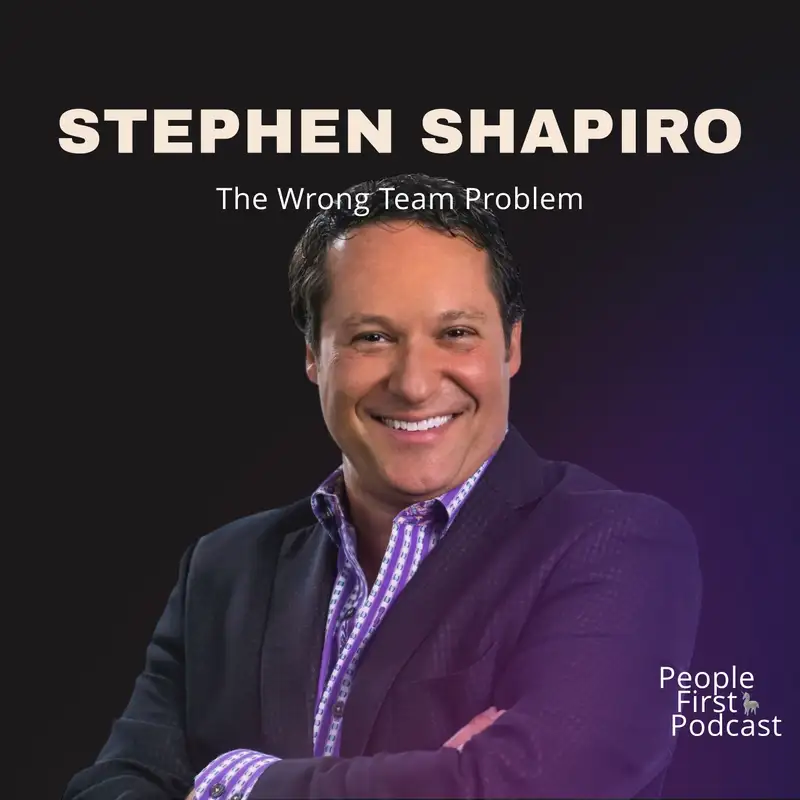
The People Who Frustrate You Are Your Advantage with Stephen Shapiro
Download MP3Morag Barrett, SkyeTeam.com (00:00.937)
Welcome to this week's episode of People First, and my guest this week is Steven Shapiro, who is the author of You're Not Playing With a Full Deck, Why the Coworkers Who Drive You Crazy Are Your Unfair Advantage. He has presented his perspectives on innovation, team building to audiences in more than 50 countries and started his work in innovation more than 25 years ago.
when he created and led a 20,000 person innovation practice for the consulting firm Accenture. He's the author of seven books. So you're not playing with a full deck is the latest of his library. And in 2015, he was inducted into the Speaker Hall of Fame. So in addition to being a successful author, keynote speaker, and also leader working with leaders and teams around the world.
So Stephen, welcome to People First.
Stephen Shapiro (01:01.356)
Fantastic to be here. Looking forward to the conversation.
Morag Barrett, SkyeTeam.com (01:04.333)
Me too. I had the opportunity to read your new book over the weekend and loved every minute of it. Not just for understanding as an individual why I might react one way in a situation and why you might react another way, but especially the latter part of the book around how this helps teams to work better together, not just on the good days when it's easy, but in times of change, transformation and uncertainty.
So I'm looking forward to diving into that in just a moment. But first, first your origin story. I'd love to know when you were a wee lad, what did you want to be when you grew up and how does that show up in who you are or the work you do today?
Stephen Shapiro (01:54.158)
So when I was, I don't know if this is a wee lad, but when I was a teenager, there's a TV show here called The Gong Show, which was a sort of a contestant show, sort of like American Idol or one of those types of shows. But the talent was terrible. And so what they would do is they would get gonged. And so the real special part of the show was the host of the show, Chuck Barris, who was just absolutely crazy, funny, wacky.
And growing up, I thought I wanted to be Chuck Barris. I wanted to be a game show host. And that's who I always wanted to be. I didn't aspire to be a business consultant or even a speaker. So what's been great is for the past 20 years since I developed Personality Poker, I've really been a game show host on stages playing the Personality Poker game with audiences. And so it's just great how things come around. It took a while to get there, but I get to do what I love.
Morag Barrett, SkyeTeam.com (02:51.849)
OK, so you've mentioned personality poker there and in the green room I was sharing, I've got several decks of those cards and I use them regularly with the clients I'm working with. So for those who might be going, personality poker, what the heck? Do I have to double down, stick, fold? What's going on? Just give us the 50,000 foot level of what personality poker that part of the concept is about.
Stephen Shapiro (03:19.832)
So the reason why I develop Personality Poker is because in business and organizations for us to be successful, we need to surround ourselves with people who are different than we are. But because opposites don't attract, we tend to surround ourselves with people who are the same. And so I developed Personality Poker, which is a card game. it literally, got the idea when I was at a casino in Las Vegas. And it's literally a card game that has 52 cards, suits callers, numbers, like a regular deck of cards.
card also has a word that describes a particular trait, such as creative, empathetic, organized, or analytical. And what people do is they trade cards to get the cards that best describe how they see themselves with the words. They gift cards to others, so we also get to see how people see us. And then the suits, the colors, and the numbers all have meaning. So when we go through the process, it's not just a very simple
two dimensional as a multi dimensional assessment that takes place in your hands real time.
Morag Barrett, SkyeTeam.com (04:22.28)
I love it. And as you say, it's multi-dimensional, it's more than just a suit of cards. And I've seen it both with that self-awareness when you're dealt your first hand and you're starting to make choices. But as you described there, when we start having those conversations with others to find out where we're similar or different, getting that outside in perspective too. But as much as knowing that I'm an ideas person and I'm
quick to decide and move forward with action in your language. I think that's diamonds and spades, isn't it? From memory. Yeah, lovely. The richness, the power that I've seen and I want to explore more with you is when I then bring it together with somebody else to find out like a Venn diagram, where are we overlapping? But also when we're doing it as a team around a table, that's when
If I may say the magic actually starts to happen because you've got that common language and framework. So in the work that you've do, you've been doing for the past 15, 20 years, what lights you up when you're asked to use these resources with leaders and teams?
Stephen Shapiro (05:38.68)
think the thing which I love the most is when people have just sort of this aha moment. mean, the subtitle sort of says it. It's all around the people who drive you crazy are really your unfair advantage. They're the ace up your sleeve, so to speak. But what ends up happening is we tend to surround ourselves with people who think like us, act like us. And there's a reason for that. Inside of organizations, we create cultures. We create cults, essentially.
Morag Barrett, SkyeTeam.com (06:07.132)
Mm-hmm.
Stephen Shapiro (06:07.15)
There's a chapter in the book called Culture Starts With Cult. And so that's what we do is people dress, we dress the same way, we talk the same way, we use the same three letter acronyms. And that is efficient for an organization, but it's also exclusive in that people who don't fit the mold don't really fit the organization. And I always joke, if you only hire people who fit the mold, eventually the organization will grow mold.
Morag Barrett, SkyeTeam.com (06:09.928)
cult.
Stephen Shapiro (06:34.274)
because you're get stale, musty ideas. And so I love when people real time, loud music playing, trading cards, being able to see who they are, but also the gifting of the cards is one of my favorite things because seeing how others see us is really quite telling.
Morag Barrett, SkyeTeam.com (06:54.044)
So say more about the gifting of the cards. What's involved there?
Stephen Shapiro (07:00.024)
So there's a few different ways that we gift cards if it's a small group. So let's just say it is a group of eight, 10, 15 people who work together and know each other well. What we'll have people do is we'll have them pick a few cards that describe how they see themselves, but we'll also have them think about a few people they know in the room. And they will then choose cards, the words that describe that person. And the way the gifting ceremony works is one person starts,
They stand up, they look at somebody in the room, and they will say, remember that time when we were all working together on this project, and we were scattered, and everybody was all over the place, and we couldn't really make any decisions, and you came in and helped us with the process. And that is why I'm giving you the organized card. And then they give the card to the other person, and then we have a little, very quick conversation, like, okay, well, does the organized card match how you see yourself?
Or is it different? And it's fascinating how often that people see us differently than we see ourselves. And there's a cost. There's actually multiple costs to the fact that people perceive us differently than we see ourselves.
Morag Barrett, SkyeTeam.com (08:15.484)
What are those costs?
Stephen Shapiro (08:18.584)
So the first cost really has to do, especially if you're a leader. So let's say you are leading a team of people and someone on your team thinks that they're a diamond, which are the creative people, the people who come up with lot of really cool ideas. But you think they're a spade, which are the data-driven people, the people who like to dig for data. And so what ends up happening is you relate to that person like they are a spade and you give them spreadsheets to work on.
They're going to be competent. They're going to do the work. They might not even complain, but at some point they're going to burn out. You're not going to get the most out of them. And so when people's work is not matched to their suit, it robs them of their energy. And so as a leader, we need to better understand who's on our team, how do they perceive themselves, and then we need to communicate with them that way. We need to praise them that way, and we need to give them work.
Morag Barrett, SkyeTeam.com (08:48.434)
Mm-hmm.
Morag Barrett, SkyeTeam.com (08:53.084)
Mm-hmm.
Stephen Shapiro (09:14.69)
that actually fits that particular suit. And when we don't do that, we're actually creating a performance issue. I've had people who left companies simply because they were perceived incorrectly. And when corrective action was taken, in some cases, they decided not to leave. So it's really critical to get that right.
Morag Barrett, SkyeTeam.com (09:32.874)
It's a retention issue. It's interesting because it links back to the gifting of the card activity that you described a moment ago. Certainly as we move through our careers, what I hear from the leaders I coach is that feedback, that appreciation, feeling valued gets rarer.
And so what you've done there is created a mechanism, not just for giving me the word challenging or whatever it might be on the card that somebody's chosen to give, but you go one step further, it's the story around, and here's why I see this in you. And the power is, to your point, it doesn't really matter whether I see it in myself. It's not only that you have had now a safe and a trigger way of giving that appreciation and feedback.
But everybody else around the table gets to hear what I'm valued for, too. So it's a way of breaking through the habits, the perceptions and the misperceptions that invariably evolve over time. So you mentioned that one of the the chat. Sorry, keep going, Stephen. I have a question, but you go first.
Stephen Shapiro (10:44.206)
Well, I just wanted to share a quick story which really gets to something you were just talking about, which is sometimes people see us differently than we see ourselves and that actually can be a gift in itself. So I was working with a bunch of guys in the construction industry. These were big, burly, bearded guys, sort of a man's man type of thing. And when we did the gifting ceremony, one of the guys gave another guy, he started telling a story, he started saying, hey, remember, it's like every project we work on.
Whenever there's an issue, you will fall on the sword. You will be the one who takes the blame or does the work that needs to be done. That's why I'm giving you the self-sacrificing card. And you can see the guy who was receiving the card, again, big burly guy, get emotional. Like the whole room became misty-eyed because it was in that moment that people felt seen, maybe in a way that they never expected, because the guy's like,
I never saw myself that way, but wow, what a gift that is to be seen that way. And I appreciate being valued that
Morag Barrett, SkyeTeam.com (11:48.82)
So I know in the introduction, I talked about the work that you do in innovation. And so for those watching and listening to this episode, I want to move even more away from the idea that this is about individual personality, but thinking about the collective results that are potential when we use this as a resource. talk to us as to how does personality poker, how does your new book help drive innovation?
Stephen Shapiro (12:17.422)
So it was actually built initially as an innovation diagnostic. I've been in the innovation space for 30 years now. And so that was why I originally developed it, was to help me better understand why organizations struggled with innovation. So it was never really a personality test. And the four suits link back to the four primary styles, which link back to the four steps of the innovation process.
And so like one of the big mistakes organizations make is they confuse creativity with innovation. They think innovation is about lots of ideas, but in fact, the first step of the innovation process is actually defining the problem, identifying the opportunity, prioritizing the work so that we focus on what matters most. This is a data-driven activity and this is where the spades excel. So they're the data-driven people.
Then we move into the diamonds, which are the creative people. And then we move into the clubs, who are the people who plan the work and work the plan. And then throughout the process, the hearts engage the hearts and minds of people. So when we look at a team, if we look at an organization, and we see suits are missing. So for example, let's just say you have a team that's missing diamonds, but you have all the other suits. I can very quickly tell you, you will innovate, but it's gonna be incremental innovation most likely at best.
And if we don't have spades on the team, you'll have lots of ideas, but they're probably not going to solve important problems. They're going to be implementing and wasting a lot of energy. So it's very powerful and simple to be able to very quickly diagnose why innovation is failing, why teams are failing, and why growth is stalling.
Morag Barrett, SkyeTeam.com (13:58.364)
It's interesting because I'm actually coaching an executive team right now and there they're missing suit of the hearts. It's the hearts and minds. And so they've got very smart people in the room individually, your spades. They are all very functionally competent. They've got ideas and plans out the wazoo. So there's your diamonds and clubs. But one of the reasons they've brought me in to help work with the team is that they were failing at the execution piece.
because they would go out of the room and go, ta-da, we're gonna go right and we're gonna run this fast and we're gonna build this. And everybody else was going, what, what? And they hadn't been brought into that vision. They hadn't been brought into the plan. They didn't understand what was being expected and asked of them in how they needed to show up differently or work differently to do it. And it wasn't until we used a tool similar to yours that that epiphany and the penny dropped.
that allowed the team to start thinking about, well, what other perspectives do we need to consider? And so I'm sure you've been asked this before. What's the right hand? What do I need in order to be successful?
Stephen Shapiro (15:14.67)
What we need as individuals are people who compliment us. And that's compliment with an E, not an I. We need people who complete our hand. so for example, I am primarily a diamond, so I like ideas and novelty. A little bit of a spade, I'm a little bit skeptical. Heart, most of the time like people. But the thing that I don't like at all are plans and planning. I find them restrictive and limiting. And so...
Morag Barrett, SkyeTeam.com (15:25.171)
Mm-hmm.
Stephen Shapiro (15:44.14)
What I know is although those people drive me crazy, they're the first people I will seek out before I do anything because I need them. And I think that's the, you know, really the key message here is, you know, at the individual level, we need to play to our strong suit. We need to make sure our teams are playing with a full deck. That is we have all the different suits represented in one form or another. necessarily hired for that team, but maybe we bring people in, consultants.
Morag Barrett, SkyeTeam.com (16:01.61)
Mm-hmm.
Stephen Shapiro (16:13.526)
advisors, other people, and then we need to deal out the work. And dealing out the work basically says that everybody can't do everything, so we do what we do best, and we get other people to do what they do best, and then we can divide and conquer and occasionally shuffle the deck where we bring multiple perspectives in. And that to me is really those four pieces are the key to a high performing organization.
Morag Barrett, SkyeTeam.com (16:35.644)
I love all the metaphors that are coming out of that. Because again, going to it is like the team I'm coaching right now. They don't have hearts on the team or a strong representation of hearts. They're outnumbered. It isn't necessarily that have to go and find more people, but the team members that are in the room, now that you have that understanding, it is choosing to lean into something that doesn't come naturally to them or give it additional care and attention where it would have got short shrift in the past.
That's how you close the gap. It isn't just a case of, well, you know, I'm a diamond or a spade, I can't be a heart, like tough, live with it. No, this is where as a leader, we have to flex. But I think the opposite is also true, that in addition to playing to our strengths, sometimes we play with our cards close to the chest and we hide our strongest suits. And that can hurt both us and the team around us.
Say more about that. What happens when we play with our cards close to our chest?
Stephen Shapiro (17:40.174)
I think the key with all of this is to play to your true hand and let everybody know what your true hand is. So the only way you can have a high performing team is if everybody understands who they are as an individual, that everybody on the team understands each of the individuals, and then we appreciate. And this is one of the key things that a lot of people sort of miss is having a team with all four suits does not guarantee success. In fact,
depending on the nature of the work, having all four suits can detract from the success of the team if you don't have appreciation for what each suit brings to the table. So it's trying to figure out what are the mechanisms that we use, how do we create an environment where everybody can thrive? And so my thought is never that if we're missing hearts on the team, all of a sudden everybody now has to become a heart. I look...
I look at these as opportunities for collaboration. Yes, everybody's multi-dimensional. So if you're a club, you probably do have some heart and you, or if you're a diamond, you might have some heart and you, those are sort of adjacent suits. But in some cases, we really do want to say, okay, well, who from outside our team do we need to bring in earlier in the process to help us get this right from the beginning? And maybe it's in a full-time position, but maybe it's an advisory position, somebody who's passionate about what we're doing that will help us be successful. So it's really,
making sure that everybody understands everybody and appreciates what each person brings to the table.
Morag Barrett, SkyeTeam.com (19:14.57)
So we've talked about understanding, we've talked about balance and appreciation. Is it possible to have too much of a good thing?
Stephen Shapiro (19:25.612)
When you say too much of a good thing to me, like every suit playing everything and doing well that way.
Morag Barrett, SkyeTeam.com (19:31.336)
Well, now I'm thinking more about some of the individual executive coaches who have gone from being assertive to being now misperceived or perceived as aggressive. Too much assertion becomes arrogance. And so that was my subtle lead the witness question.
Stephen Shapiro (19:45.832)
Yes, okay.
Yes.
Stephen Shapiro (19:53.58)
Yes, yes. So in Personality Poker, I talked about numbers and the numbers in the deck of cards have meaning. And the two, three, four cards are what I would call your strong suit gone wild. These are sort of your strong suit on steroids. So being an analytical spade, a data-driven spade, those are fantastic things. But if you're a know-it-all, you're not going to be a lot of fun at parties. People don't want to hear you pontificate all of the time.
For me, I'm a diamond. So I'm creative, but I'm also very disorganized and scattered which are the two three four cards and We need to the balance right Because if I tried to be organized, I will stifle my creativity There's a ton of research that shows that the most creative people are disorganized and messy but it can go too far and so it's getting that right balance of
really truly embracing that two, three, four card. And I always joke that the difference between a Timex and a Rolex is the three of clubs, which is the anal retentive card. We need people who are very detail oriented to get something that's gonna have that Swiss precision. But you can't do that all the time, otherwise you will drive people totally nuts.
Morag Barrett, SkyeTeam.com (21:07.338)
Mm-hmm.
Morag Barrett, SkyeTeam.com (21:12.394)
So in the years from when you first conceived of personality poker and to where you are today, what's been most surprising for you in that journey?
Stephen Shapiro (21:25.112)
think the thing that surprised me from the beginning was how intuitive it was. So the first speech I did, when I came up with the idea over 20 years ago, I created the deck of cards, I printed the first decks, did my earliest speeches were actually with prototypes that were printed on cardboard, but you gotta test things out. And so my first real speech where I had decks of cards, and by the way, I never planned to sell decks of cards, I never planned, it was a speech, that's all it ever was.
And after the event, a CEO came up to me and said, hey, I wanna buy decks of cards. And I'm like, I don't sell decks of cards. It's just for the speech. like, sell me decks of cards. It's like, I don't have instruction manuals. I don't have any training materials. I have nothing. I just have decks of cards. He I'll figure it out. I'm like, okay. So, sold decks of cards to the CEO, smaller organization, figured it out perfectly, did not need instruction manuals.
And in fact, he gave me some insights that I'd never considered. For example, the big insight he gave me, which I thought was brilliant, and I love it to this day, is that he realized meetings have personalities. So people have personalities, meetings have personalities, teams have personalities, organizations have personalities, and in the case of meetings, he realized all of his meetings were club meetings, status reports, but he didn't have the brainstorming diamond sessions. He didn't have the team building, empathy-oriented heart meetings.
So the first thing he did was he made sure he was playing with a full deck of meetings. And then it goes further from there, but it's just like amazing. So that's, guess the big surprise is how intuitive it is. There's a lot of ways to use it where you can go a lot deeper, but a deck of cards just in somebody's hands, they know what to do with it almost instantaneously.
Morag Barrett, SkyeTeam.com (23:12.902)
Isn't it interesting because that kind of appeals to the diamond nature and the idea and innovation that you had the idea, you use it and look how it's blossomed and grown and had an impact for thousands of leaders across all sorts of organisations acting as that common framework and language for diagnosing individual personality. But now you've layered on the meeting personality, the organisational cultural personality.
And now we can make an informed choice of where do we want to turn the dial up or down now mixing my metaphors. So what's next for you? I know the ink isn't even dry on the new book, but what's next for you in terms of innovation and continuing to bring this to lead us in new ways?
Stephen Shapiro (24:02.744)
So I'm building some new digital tools. Fortunately, AI makes this process a lot easier. So for example, I just launched a free assessment just on my website called the Who Drives You Crazy Quiz. And what it does is it simulates personality poker. You choose five cards for yourself and you choose five cards for the person who drives you crazy. And then it will tell you why do they drive you crazy. It'll tell you their suit, your suit.
why they drive you crazy and why you need them, why you might be rejecting them, but why you need them. And so I really plan on going deeper and deeper into tool development, but the anchor for all of this has to be physicality. Because to me, the real value of personality poker, I don't want to turn it into a digital product. It is the physical cards and the conversations that take place that are its true value. Once it becomes digitized too much,
then it becomes like everything else out there. So to me, this is about conversation, not necessarily labeling.
Morag Barrett, SkyeTeam.com (25:08.884)
OK, I look forward to seeing how that evolves and maybe incorporating that into our practice here at Sky Team. So as we come to the end of our time together, first off, what's the message that you hope that listeners and viewers take from this conversation?
Stephen Shapiro (25:27.01)
think the key thing is to just look at yourself, look at your team, look at your organization, and be honest with what is valued. So if we can understand what we value as an organization, and then the second question is, what don't we value that's costing us? What don't we value that we should, because if we could start valuing it, it would have a positive impact on our organization.
And so that to me is really the most important thing. It's not about, even though I say playing with a full deck, which means having all the different styles, it really is more about valuing all the suits, what their contributions are, and creating the right environment for everyone to thrive.
Morag Barrett, SkyeTeam.com (26:12.842)
How can people learn more about you and your work Stephen?
Stephen Shapiro (26:18.604)
So for me, you can go to theinnovationspeaker.com. That just takes you straight to my website. If you want to learn more about Personality Poker, it's personalitypoker.com. And the new book is fulldeckbook.com. So lots of easy places to find me.
Morag Barrett, SkyeTeam.com (26:35.358)
Wonderful. make sure all of that information is in the show notes. I would encourage you to get a copy of that new book. You're not playing with a full deck. It is a quick read and that doesn't mean that it's short. It hits a powerful punch with wonderful insights at every stage along the journey, moving from the hand that you've been dealt, your own personality, to how do you play to win with others, to then mastering the hand that we have individually and collectively.
so that we can ensure mutual success, which as you all know, is music to my heart and at the heart of the work we do here at Sky Team. So thank you for joining Stephen Shapiro and myself here on this episode of People First. I look forward to seeing you all next time.
Creators and Guests