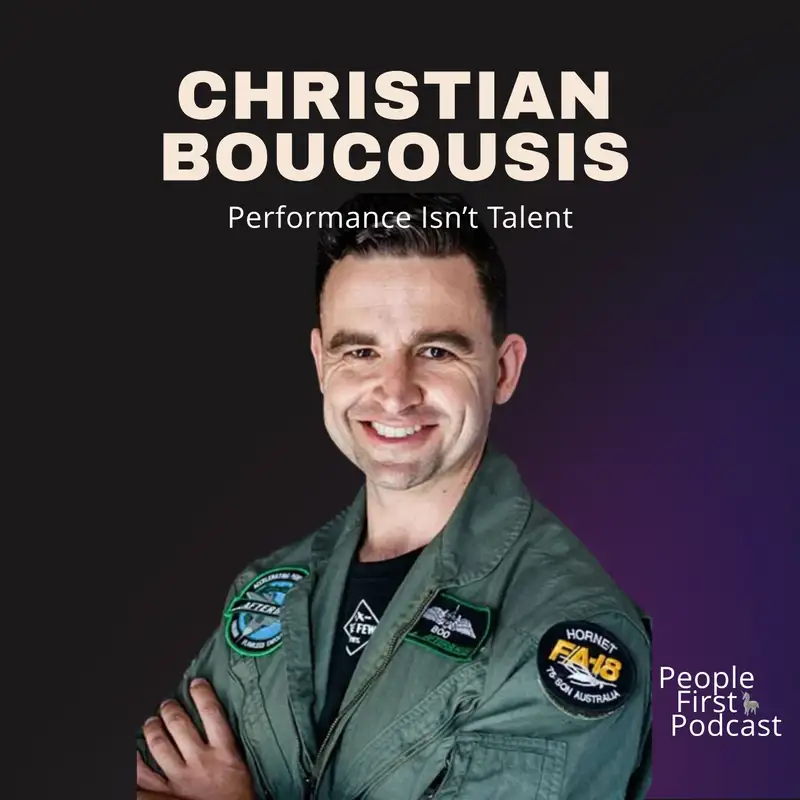
High-Performance is Designed, Not Hoped For with Christian "Boo" Boucousis
Download MP32. PODCAST OPENING AND INTRODUCTION
MORAG BARRETT:Welcome to Sky Team's People First with Morag Barrett. Here we'll be exploring the people's side of successful businesses, careers, and lives. We all have a story to share, and there's something to be learned in every story. Join us to learn from authors, business leaders, thought leaders, and people just like you to uncover the latest ideas, resources, and tools to help you become more effective at work and life. As it turns out, the Secret to success is cultivating winning relationships. Business is personal and relationships matter.
3. GUEST INTRODUCTION AND ICEBREAKER
MORAG BARRETT: Welcome to this week's episode of People First. And my guest this week is my new friend and colleague, Christian Boucousis, who is a former fighter pilot turned CEO of Afterburner. He is the author of the Amazon bestseller, The Afterburner Advantage . And we're also going to be talking about his new book, the ink is not even dry yet, Flawless Leadership . Chris has worked with over three and a half thousand organizations and 2 million leaders worldwide, including Super Bowl-winning NFL teams to bring clarity, alignment, and speed to leadership. Chris, also known as Boo, and his Flawless Leadership system helps leaders cut through complexity, focus on what matters, and achieve consistent results without burnout. Sounds fabulous. Boo, welcome to People First.CHRISTIAN "BOO" BOUCOUSIS: Thank you, Morag. I was wondering when you were getting to Boo, I knew you were uncomfortable whether you could make the leap or not. You did it. Well done.MORAG BARRETT: I made it. We thought I thought I'm going to go through the transition. We're going to go because I bet on your books it says the full name. It doesn't say Boo.CHRISTIAN "BOO" BOUCOUSIS: It does. Yeah. You have to if you have an Amazon author's profile. Unfortunately, they just wouldn't accept Boo as a real name.MORAG BARRETT: Well, then boohoo to them. So, you're right. In the green room, I was saying this is just fighting every bit of my Britishness to call somebody Boo, but I will call you Boo. There you go.CHRISTIAN "BOO" BOUCOUSIS: There you go. Perfect.
4. CORE CONVERSATION: THE ROLE OF RELATIONSHIPS
MORAG BARRETT: Well, welcome to People First. So, as you know, my work is all focused on the importance of our workplace relationships, the fact that the world of work, whatever industry we're in, is a team sport. So, as a fighter pilot, what role have relationships played in your success?CHRISTIAN "BOO" BOUCOUSIS: Oh, everything. I mean, if you look at the way humans learn, we learn from books, but we learn about leadership from watching, observing. It's kind of like a sponge because leadership can be such an ethereal kind of thing. And it's interesting where your focus is on people first and the reality is that is not where the world is going as we get into human machine fusion and that's what Flawless Leadership is all about. It's about helping leaders understand where technology works, where it doesn't, and how to show up as a human-centric leader as well as a tech-driven leader as well as a fully aware leader rather than what we call the leader of existence who just ponders through each day doing the same thing.Relationships—I left the Air Force, I'm not very good at math, 21 years ago, and those are still the strongest relationships I have in my life. Everyone from my pilots course when I was 19 through my squadron life through life in general. When I travel back to Australia and now live in the US, they're the people I connect with again and we'll sit down for three, four solid hours and just talk about everything like every possible thing you could imagine, whether it's politics, how are relationships—it's like that best friend that accepts you for no matter what you are or what you do. I've gone through life, been divorced twice, had challenges in business and these are the rocks, these people.The challenge with relationships in business is business gets in the way of the relationships. We end up in this kind of mixed bag of work feels personal and what feels personal feels like work. Therefore, we don't break through that fourth wall. What the Air Force does really well is because we're so defined as to what work looks like and what good work and less than good work looks like, we can have really transparent conversations that aren't personal. And then because we missionize everything, everything has a start, a middle, and an end. When it's the end, it's just fun. It's just chatting in the crew room. It's laughing. It's the banter. It's just being around really competent, high trust people in a squadron of 250 other people that everyone trusts and you're able to build much better relationships because everyone knows what they need to do. Everyone knows when it's a good job. Everyone knows when there's a problem, everyone pitches in. You define everything that's definable and that frees up more time to be more present with when you're with other people.MORAG BARRETT: It's interesting as I listen to that, there's so much going through my mind because I say that the art of the conversation is something that seems to have atrophied especially post pandemic but with our phones in front of our noses you see so many people out and about with their friends or family but noses facing here. And then you were talking about how in the air force everything was missionized and I'm thinking about my first call today with a potential new client with an executive team and an executive team coaching scenario and the contact I was talking to was saying, "Yeah, we don't have the psychological safety. And to be honest, we just need to have fun." They're so focused, as you said, on the business that they're all wearing a mask of here's the role I'm supposed to play on this team, but as a result, they're not getting to the real conversations that are helping them to accelerate the business, but also achieve the results that they're just not aligned around. And so, breaking through the fourth wall for me is at the heart of the work I do. So where does Flawless Leadership bring all of these threads together?
5. THE FLAWLESS LEADERSHIP SYSTEM: MINDSET
CHRISTIAN "BOO" BOUCOUSIS: Well, fighter pilots, we love concepts. We love connecting with why, purpose, all that stuff. And in our world, that's really easy. The saying we have as a fighter pilot, particularly as an instructor, as a leader, is don't live in the world of what, live in the world of how. And when we talk about psychological safety, I mean, no one wants it, but how do you do it? Yeah. And so we have a system. So Flawless Leadership is the system that transforms leaders from overwhelm to impact. We say there's only one way you can make an impact, and that's to create a target and hit it. And when you hit a target, you make an impact. Which then gets leaders to start thinking a little bit more around those targets. What's the target from a personal perspective? What's your personal win? What's the target as the collective team win? What's the target as the business? And once you know what those are, you can lead and start to create alignment between those three.So Flawless Leadership is mastery of the three dimensions of leadership: Mindset, Method, and Moments. That's all you need to know. That's all you need to master as a leader. So when we talk about mindset, we talk about the mindset a fighter pilot has. And when I read Carol Dweck's book 20 years ago when it first came out, the first book on mindset, I just read it and it was like a "duh." Like, why is this a book? This is the Air Force. This is exactly how we do everything. And again, at that time, not being particularly outside my own bubble of fighter pilot world, I didn't appreciate—and I do now as the CEO of Afterburner and as a keynote speaker—just how clueless people are on what mindset is.So we built a system of mindset. We call it URKA (or IRCA ) where you set your mind to the future. So you are very Intentional. Everything you every thought starts with where am I going, not what am I doing. Secondly, it's Transparency around your Reality. Like of this environment and things not going right. How much of this situation is me versus the environment? And let me give you a hint: 100% you. Then we go into Curiosity and we ask ourselves, what is it about me that isn't getting me to where I want to be? Do I not have a skill? Have I not done enough research? Am I not healthy enough? And then the A in URKA is Action—like just do something. Do something small that you can do the first thing you do in the morning or immediately after the event. And when you do this that creates what Carol calls a growth mindset. Like you grow every day and you don't grow through thought, you grow through action. So that's the first M.
6. THE FLAWLESS LEADERSHIP SYSTEM: METHOD
CHRISTIAN "BOO" BOUCOUSIS: Then we have a Method and the method we use at Afterburner—and Afterburner is a 30-year-old company that's been bringing fighter pilot stuff into business—is we have this Plan-Brief-Execute-Debrief cycle, which is really just Missionization . And what it means is Plan-Brief-Execute-Debrief . When we talk about being busy and doing, it's only one of four steps in life and in business. It's the only step that most people take. It's just work all the time. Just be busy, busy, busy, busy, busy. So we say okay let's just break that cycle. Let's come up with a plan here. Let's figure out what we need to do. And the plan is: what's the plan for you personally? What's the plan for the team? And what's the plan for the organization? And let's get all that rough into a plan. We have a six-step process for that. I'm not going to go into that now because we're starting to nerd out a little bit.MORAG BARRETT: Oh, and I even picked up my pen. I'm making notes.CHRISTIAN "BOO" BOUCOUSIS: And it's in the book. It's in the book. Everyone can download the book for free. Upload it in your chat and you've got a fighter pilot in your chat.MORAG BARRETT: Okay, you heard it. Download it, upload it, but do it.CHRISTIAN "BOO" BOUCOUSIS: Just we're just here—free stuff. Make the world better. You know, when you say plan, all you're doing is saying have a think about it. And when you think about it, think about it together. It's a together thing. We call it an open planning process, which means we're open, open palms, open minds, and it's open to anyone who's involved to be part of it.Then because when we talk about the reality of who we are and the biases that we have, we bring this piece to the puzzle called the Intentional Challenge . And Intentional Challenge means instead of receiving criticism during the mission, let's get it now before we even start. And we call that a Red Team . And that's where someone that isn't invested in your journey or your destination—you just run the idea past them, run the plan. And they just say, "Hey, have you considered this? Have you considered this? Have you considered this?" And then if you're on the receiving end, all you do is say, "Thank you. Thank you. Thank you." There's no conversation. There's no justification. It's just a one-way conversation. Now, more often than not, you'll get two or three questions that you're like, I didn't think of that. That's really good. And the rest of it you've probably thought of, so who cares? Keep going.So, that's the ideation piece, right? So, we've designed a future, but the future doesn't exist. So, the next step is Brief. And when we say brief, brief by name, brief by nature. And this is what we replace Meeting Culture with Briefing Culture . And when we talk about brief, what we're saying—and it's counterintuitive—is it's not what you say in the brief, it's what's understood. So, it's more about the meaning of the words rather than the words. And you can only be aware of whether people understand by asking questions: What's the plan? What's the next step? What's your role? How do you know when it's done? Who do you rely on next? What happens after that? And that creates this cognitive shift from passive receipt of information to proactive engagement in the content and then we go and execute. Right? So we've designed the future, we've answered all the questions. Now we don't need any more meetings because everyone actually knows what they're doing and we just free up the rest of the day to get it done.Then at the end of the day, we come back and we say, "Hey, did we get everything done that we said we were going to do today?" We call it the Debrief. It's the glue that holds today to tomorrow. And it's called ORCA . O-R-C-A. And we just turn into ORCA and the only difference is the O means Objective . And this is a key for relationships: if you want to do work, be objective. Don't be subjective. Be objective about everything.MORAG BARRETT: Sounds so easy. Be objective not subjective. But we go back to the hidden biases that you mentioned earlier. But keep going because this is nerding out geekland, I love it. Keep going. So, ORCA ?CHRISTIAN "BOO" BOUCOUSIS: Yeah, so when you have an objective, all that means is you have a Narrative and you have a Number. You got to have both. You can't just have a narrative and most organizations live on narrative. The problem if you live in narrative and you don't have a number, the narrative becomes a story and you read stories, you don't do stories and that's a very important shift for a leader. Intention is a story and it's important but execution is an objective. It needs to be done.MORAG BARRETT: And those stories I assume are myths, legends, horror stories that then keep people stuck because they don't have the number that shows what did or didn't happen.CHRISTIAN "BOO" BOUCOUSIS: Exactly. So, this is the missing link in most organizations. So, when we have a number which is the number we want to get and then we have another number which is the number we actually got—and just remember here everything we do in planning and in leadership is best guessing because leaders are moving to the future that doesn't exist. So, it's very unlikely that just because you plan it and just because you put a number on it it's going to happen, but it does give you a point of reference once we understand where we should be versus where we are.We get into the C of ORCA which is the Cause. And we use that word cause because something had to cause the result. It's a bit stronger than curiosity. And the cause is a person. It might be an AI agent now. The cause is someone had control of something that didn't deliver and what happened there. And then once we understand what happened, we just have to do something about it and the A is the Action. What is the next thing that you do?Through this process we tick all the boxes. We tick the atomic habits. People only define habits through identity. So we start to create identity through these conversations. The actions in themselves become habits because if you debrief all the time, it's very unlikely that the same things are going to happen again and again because you're actually fixing them and you're creating the psychologically safe environment that fighter pilots call nameless and rankless. And what that means is in a debrief, it doesn't matter who you are, we're all in service to the objective, not each other. And that's how you just make everything not feel personal. There's nothing more psychologically safe than not talking about personal things. It's just the overriding principle is the focus on what's right—the data and the metrics of success—versus who's right—the opinion of performance.You can see within that conversation, 99.99% of businesses don't have it and they don't operate that way and that's the opportunity because it is only four steps. The challenge is most companies don't have objectives or if they do they're very big. No one actually understands their role in the success or achievement of those and as a result every time we have a meeting, which is really a debrief, it is looking backwards to move forwards whereas a meeting is just looking backwards to figure out what on earth is happening.MORAG BARRETT: To point finger and blame invariably and that's where it gets stuck. We call it the excuse matrix. All right, let's bring out the excuse matrix. What are the 100,000 things I can't control that I can blame this on?CHRISTIAN "BOO" BOUCOUSIS: So again a rule of debriefing is no excuses. You can have the excuse, but then what? Get back to the individual. We had an event, it rained. Okay. So then what did you do? I didn't do anything because it rained. Okay. Well, that's not what we do. So let's work out a plan now for next time that happens. And if it rains, what is it we're going to do? Are we going to make sure we have an indoor facility booked? Are we going to move to another time of the year where the weather's a bit more stable? You know, there's a whole bunch of stuff that you can do. And then you can break that all the way down to the coding layer of building an app. It's your fitness goals, your dietary goals, your life aspirations, your studying to learn French. All of it can operate within this framework. The problem is everyone approaches work without a framework. That's why it doesn't work. You have to frame the work for it to not be work.
7. THE FLAWLESS LEADERSHIP SYSTEM: MOMENTS
MORAG BARRETT: Mindset, Method...CHRISTIAN "BOO" BOUCOUSIS: And the final one is the Moments that we show up as a leader. This is really the application of the mindset and the method in the three different moments.The first moment we have is we call that the People Leadership Moment . That's the human-centric moment and there are a few rules about operating in the human-centric moment of leadership. It's a zero technology space. There's no phones, no watches, no laptops, nothing. It's pure human connection and there's no discussion of work. It's all personal. People aren't very good at those conversations. So, we say use the six steps of planning to frame your personal conversations. Ask the person, "Hey, what does good look like to you at the end of the week? What does good look like to you at the end of the year? How's it going? Are you there yet? What do you see as some of the challenges? What do you want to develop? What can I do to help you? What do we need to do as a team?" And all of a sudden, people that find having conversations that are difficult become super easy.Then the second moment of leadership, we call that the Impact Leadership Moment . And those are the moments in business that we measure. So it's successfully hitting a target, achieving a target, missing a target. And to be an impactful leader you have to be crystal clear as to what everyone's objectives are. It's a focus on where we're going and that everyone in the team knows where they're going for themselves and that we just let them get on with the work to get there and we frame it up with debriefing. So we plan the metrics, we brief the metrics, we execute the metrics, and we debrief the metrics. And that's how you get your meetings down from an hour to 15 minutes. And we have a 90-day program in our organization. We bring all those down to 15 minutes. Which is very powerful. Fannie Mae was one of our clients and we got them down from 8 hours of meetings with 200 people on a particular program to 23 minutes of meeting with only 20 people on the program because they did all the work. They did all this stuff.MORAG BARRETT: What did they do with all that extra time? Did they go have fun? I mean that's huge.CHRISTIAN "BOO" BOUCOUSIS: Well, they got the work done and the project actually finished rather than the two years it took to figure out what they're doing. I had another organization, Woolworths, which is the biggest supermarket in Australia. The seven leaders I worked with there after a year, they're like, "I'm going to lose my job. I've got nothing to do." And I'm like, "No, now you're doing your job because all you're doing is thinking. That's your job as a leader. You got to do the thinking. You got to do the design."And then the final moment we talk about in leadership is Leading Now . So that's the second-by-second leadership decisions that you make. And the overarching principle in Leading Now is being a leader of awareness, not existence. So, if you don't know where you're going and you're not an impact leader, you won't have any situational awareness during the day, you're just going to be reacting and looking at your inbox all the time and you're going to be on meetings for 10 hours a day because you're trying to find awareness that you're never going to find because you didn't design the future properly. So, in the now is about situational awareness. It's about executing the plan.And all of us as leaders transition those three levels. It doesn't matter whether you might not see yourself as a people leader, but if you're a forklift driver, you're leading that task for the day. You're 100% responsible for moving the boxes around and getting everything where it needs to get to. So, you are a leader. It's just you're more focused in the leadership now moment. When you start to talk to your boss, you're coming into the impact layer. And if they're not talking about you or your personal goals, you have to shake the conversation to get up into the people leadership layer. So leadership is a one up, one down. You lead up and you lead down.The whole concept of leadership is going from where you are to where you need to be. That's what leadership is—dealing with this unknown. Management is the other way. Management is just overseeing what's already happening and kicking people in the ass when they don't do stuff. And that whole world is going to cease to exist in about 5 to 10 years when the machines do everything. They do exactly what they're told and there's going to be no excuses other than bad leadership and bad planning when the machine does something wrong. So we're moving from this era in leadership from doers to directors and also from an era where leaders make decisions to where they have to create frameworks for machines and other people to make decisions. All of this is just now highlighting how bad leadership is. It's just becoming more and more obvious.And if you look at 2025, there were more CEOs fired in 2025 than any other year in history in the United States. So, there's another red flag. You look at the way countries can't even talk to each other anymore. You look at everywhere you look right now, leadership is not delivering impact. It's just a mess. So Flawless Leadership , it's like, hey, if you're a good person, but you kind of struggle how to lead because you're not one of those alpha personalities or a psychopath. Use this system and you'll get a voice at the table. Use this system and we're going to start elevating really good people into a position where they can influence people at the people layer, they can get things done at the impact layer, and they can empower people to make decisions at the Leading Now layer of Flawless Leadership .
8. CLOSING REFLECTIONS AND CALL TO ACTION
MORAG BARRETT: So it's interesting you shared your reaction to Carol Dweck's book where you went, "Duh." I mean, why does this need to have a book? And in some ways, as I listen to this, I'm going, "Duh, yeah, why do we need a book?" But what I do love is the way that you've framed it and made it accessible. You've named what we all know implicitly, what we all BMW about at the end of every faking day—bitch, moan and whine. You won't believe what happened at work today. But you're also naming what we see in the morass that we swim in every day. But you're also turning the mirror on ourselves because it's like okay but you can't just say they don't know—what can I do as an individual at my leadership level whether it's forklift driver or CEO to start to affect change? So in the work that you're doing with the teams and leaders that have brought you in, firstly where is the biggest resistance of "duh, but we can't hear because we're special"? We can't hear because we tried that five years ago. So, where's the resistance? And where is the deceptively simple quick win that can have the biggest impact?CHRISTIAN "BOO" BOUCOUSIS: Yeah. So, the main problem is busyness. That's the that right now in the world. It's too busy to think. I'm just any single thing that I hear that's new, I just can't process because I'm so lost in what I'm doing. I am buried in my history. I'm not even invested in the future. That's the challenge. That's the challenge for us in terms of selling as an organization. It's the challenge that we see when we're implementing our programs, the last minute cancellations. "Oh, we're too busy to sit down and think about what we're doing. We're too busy for that." And it's like, well, you know, that's the problem. I mean, that's it right there.The quick win is just invest in understanding what debriefing is because debriefing is the catalyst for everything because it's always about "and then what." And what you normally find—and I say this to people like "I just feel like I'm stuck in my life"—and I'm like, well are you stuck or just not moving? Like where are you going? I understand if you're stuck on the way to somewhere but if you're not on the way to anywhere you're not stuck, you're just immobile. You've made the decision not to move. So, there's nuance in those words as well. And that's what debriefing does because the first question you ask yourself when you sit down is what am I trying to achieve? I feel this way because of what? What is the expectation that's not happening to make me feel this way? And that's what we're not very good at.Secondly, as we get older, we're typically—we've lost our motivation and we've become cynical because we've tried to do so much that didn't work. And the only reason it didn't work is because you didn't debrief. If you debriefed, you would have got there. I've built four multi-million dollar businesses from scratch and I've never been to college. I barely got through high school. I firmly believe that whatever I want to be and whatever goal I want to have, I will get there. You just got to debrief. I don't know how long it's going to take.And what you find in debriefing is companies want to debrief today's results, but when you get into it, it's not today's results that's the problem. There's just no system here. Everything is open to interpretation. So you and I'm not talking about things that require flexibility. I'm talking about a company that runs a factory and there's defects all the time. And there's defects because it was designed wrong, but no one wants to talk to that person because they're the founder of the company that designed everything and it couldn't possibly be them. Or within the production line itself. They're using old production techniques and tools to build a new product because they don't want to invest in the new tools because it's too expensive. And then they get into this—we call it the death spiral where they didn't do new right and now it's costing them money. They don't want to spend the money to make new the standard because they didn't bother to spend the time planning. I'm talking very generically. Some companies do this exceptionally well. You look at Lego. I mean, Lego realized that they can from scratch build a factory that can take buyer demand for products and re-engineer the factory floor to make more of those products within two weeks.MORAG BARRETT: It's that whole we know there's a problem, but let's pretend it doesn't exist. But even when we choose to accept there is a problem, oh, but it's too difficult, too expensive to fix. Meanwhile, we know the problem is only going to get worse. But you know what? Not my shift and the next person can deal with it. And also maybe that there's not going to be any glory because going back to busyness, the other thing that we celebrate certainly in the western career path is, you know, you either come in and fix or you meet your goals and you get promoted to that next level. So the idea of taking on this hairy redesign, this could be career limiting, but the irony is it's career limiting for everyone if we don't fix it. So you're in this kind of damned if you do, damned if you don't.CHRISTIAN "BOO" BOUCOUSIS: Yeah. And whenever you fix something, it requires work, right? And everyone's too busy to do work. But the current work we're invested in is the work in something that's broken, not fixing it. In the book after Flawless Leadership , I have a chapter called the Avenger Effect , which is this inner narrative leaders have that says if I'm a superhero, I get rewarded. And as a result, they exhibit all those behaviors you were just mentioning. They want to save the day. They take over from their people. They want to make sure that they unconsciously cause problems to solve to support their narrative of I'm a superhero.MORAG BARRETT: Yes. And I have something similar in Cultivate . I talk about that hero mentality. I'm here to save the day and I get rewards. But then again, at worst case, you get arson, i.e. I start the fire in order to be the hero to put the fire out and that doesn't solve anything either. So let's go all the way back to the mindset piece. I want to ask about psychological safety because the example you gave in moment certainly you said People Leadership Moment , it's the human-centric bit, no technology, it's all personal, no discussion of business and yet what I heard in the example was tell me where you're going which is business adjacent. Where do we get into the truly personal?CHRISTIAN "BOO" BOUCOUSIS: Well, it has to be business adjacent because if you want to buy a new house with your new fiance, the only way you're going to get there is through work. And if work can help you get there faster because you can have a conversation around—look, I have a philosophy that—well, it's not my philosophy, it's well researched that one high performer is equivalent to seven normal employees, right? So to me inside every person there's seven times more. So if you're really smart on this and your intentionality, you're a flawless leader, you would say my personal ambition is to buy a house, my personal ambition is to have a BMW—whatever it is, can be shallow, that's fine.You can say to somebody, "Hey look, boss, I'm willing to do two people's worth of work and get the results that two people can get, but I want this compensation for the extra work." Now, the challenge there is that a boss goes, "Well, no, no, no, no. Why aren't you doing two people's work for nothing?" At which point you can say, "Well, boss, research shows..." and this is where intentionality comes—be informed to have these conversations. It's where you can have a conversation with a boss and say, "Hey look, you and I both know that within this team, we're not achieving our full potential. And that's okay. The company accepts that because it's been like that since I've been here for two years. What I'd like to say is I think I'd love to be a catalyst for change. We've been doing some research. This is what I've read. I think I can do this."It's not really that person's obligation to make the decision, but it is their obligation to inform the leader. Now, if their leader was a flawless leader, they'd go, "Hell yeah." And the way that I'm going to get that is I want to see two people's worth of results. So, if one person's closing 200,000 a year in deals, if you close 400,000, I'll give you a big bonus. Everyone wins in that scenario, but no one has those conversations. Very, very rarely. Some people do it. And again, Flawless Leadership is to help people that aren't naturally good at this stuff. People are naturally good at this stuff, and they're the ones that are very successful because they do operate like this. They are very intentional. So they are always framing every conversation as this is what's in it for me and this is what's in it for you. Do you think that's a good idea?MORAG BARRETT: Flawless Leadership . It's pulling what we know implicitly but either don't yet have the confidence or capability to do explicitly. I've yet to meet anybody who gets up in the morning thinking I want to be a below average performer. Everybody's trying to do their best but they're beaten down by the system or they don't yet feel empowered to change the system in order to get to that one high performer equals seven average employees. We could all elevate, but this is a shift. And so as we see AI, as we see the current implications around the world, why do leaders need to care about this? Why do they need I think what you call the next generation leadership mindset?CHRISTIAN "BOO" BOUCOUSIS: Well, you just said the word which is care. That is what humans can do that machines can't. Machines don't care. They don't have emotion. I mean, there's a whole rabbit hole you can go down with the AI geeks. They say, "Oh, we can have emotions." But as it stands now, you've got to create space to care. And there most organizations... yeah, I work with hundreds of organizations. Some do care. Some are phenomenal. Like some you see it because you know we go and do their annual event and you can see at that annual event how much they care for people. You go to other events and they don't care. It's terrible.MORAG BARRETT: They're going through the motions. It's check the box.CHRISTIAN "BOO" BOUCOUSIS: Correct. We got to do this. This is a budget problem. No, no, no. So, a big part of being able to demonstrate care is the time to disconnect with the task positive network of the brain which is the very analytical work brain and get into the default mode network, the creative structures of the brain, and flicking that salient switch from on to off. So the busier you are the more on you are—that's not the human connection relationship part of the brain, that's just the get shit done brain. Click into the other gear. So meetings from 7 till 7—click—task positive network—don't care—click out of that—oh now I've got space to care. So even at the end of a keynote I'll say to everyone just right now just go in and change all your calendar default timings to 30 minutes because it's defaulting for an hour because Microsoft wants you to spend that amount of time on Teams. That's how they measure success is hours of usage. They don't want you to use it less. So be intentional about your time and that's also a very powerful frame of mind for a fighter pilot because we engineer everything to execute at seconds, minutes...MORAG BARRETT: Get in, get it done, get out.CHRISTIAN "BOO" BOUCOUSIS: ...not days, weeks, months, and quarters. So, if you're focused on making one decision a day as opposed to one decision a second, even if you get a little bit closer to the decision per second, you're going to be moving from unknown to known much better because decision-making is the transition from unknown to known. Once you make the decision and something happens, now you know. The more you defer it, the less you know. I worked for a CIO in one of Australia's biggest banks. He used to call it intellectual masturbation. He says all this company likes to do is sit and intellectualize everything because it feels good. Nothing gets done.MORAG BARRETT: Oh, I love that phrase. It's going to make me blush. But I love it because it is—it's the hot air. We admire the quality of the problem. We admire the options available to us, but nobody goddamn decides to then find out is it going to work or not. And even if it doesn't work, well what's our next best guess to your point right back to the beginning so that we can keep iterating and moving forward. We get this paralysis by analysis, but I love your phrase too.CHRISTIAN "BOO" BOUCOUSIS: Yeah, and that's the thing—I don't even think it's paralysis by analysis. I think it's just plain old paralysis. I think it's fear and analysis is the excuse. So Debriefing removes the fear because it says stuff's going to go wrong. We get that, but we're going to catch it early. Most companies reflect after a catastrophic event or after a negative event. Debriefing is designed to stop the airplanes crashing. If we only debriefed when the airplanes crashed, hundreds more would have crashed. It's all the little things systematically that lead to the crash that can be course-corrected along the way. And then, like in Australia, nearly 36 years, no crashes. None.So, if you think about it in terms of: I take off and then I land or I crash. The objective is the takeoff. The result is did it land or did it crash? And the cause is the reason for the crash. But it's not a big deal because it wasn't an actual crash; we picked it up earlier than that. And the action is going to stop the crash. There's this whole risk model called the Reason Model and basically you put a whole bunch of discs in a row and you shine a torch through them and every disc has a hole in it. And one day all the holes line up and the light gets through and that's the day that something goes wrong. So you want to sit there and make sure that the discs are always turning so you never have that moment or that moment is incredibly infrequent.MORAG BARRETT: Cool. Cool. So Flawless Leadership , you said earlier something about download. So how can people learn more about the work that you and your team are doing and the concepts that you've shared in this conversation?CHRISTIAN "BOO" BOUCOUSIS: Yeah, so The Afterburner Advantage —the book itself is the methodology. It's really heavy on methodology, a little bit on moments and a little bit on mindset. And Flawless Leadership , which should have been launched already, but thanks to AI, I had to rewrite it to be more human machine leadership, will be out kind of mid-year this year. That's more into the 3M. But I'll make sure we send a link where people can just download an e-copy of The Afterburner Advantage and they can just upload that straight into their GPT and you can set up a planning agent to help you plan. You can set up a debrief agent. You can set up a "I just want to be a better leader" agent. And it will just frame all the context of the book into your very specific problems.MORAG BARRETT: I love it. So that's all about busy and doing and everybody's going to go, "Oh yes, let me do that. I'll download it and I'll get to that later." So final words, what are you hoping that people take away from this conversation?CHRISTIAN "BOO" BOUCOUSIS: It's on you. I mean, it's simple. Do it or don't do it. I can only help people that want to do it. If you don't want to do it, then what happens tomorrow is going to look eerily similar to what happened today, which probably looks eerily similar to what happened the day before. So, if life feels "meh" and it's just the same, download the book and get started. Just even a very simple prompt like "I want to be different. I just don't want my life today. What should I do?" And the book will craft you through the journey to help you get there.And the biggest thing it will help you with is not "I want to be different." It'll help you with what to do tomorrow to start that off. It's a little bit like Atomic Habits . "I want to run a marathon" is very different to "I'm a marathon runner and I'm running the Boston Marathon." Once you identify as the thing you want to be, you'll do the work to get there. So with the book, it'll help you create that identity and then build the habits for the identity to become who you are. And I know it works because before I joined the Air Force, I had no identity. And then when I left the Air Force, I had the identity of a fighter pilot, which has served me well for the 20 years since I've left. So, it kind of works. It works at scale.MORAG BARRETT: You are the poster child. Well, Boo, this conversation has been truly invigorating. Evidenced by the fact I actually picked up my pen and made copious notes. I look forward to our ongoing conversations and I'll make sure all of those resources are added to the show notes below. But thank you for joining me here on People First.CHRISTIAN "BOO" BOUCOUSIS: Thanks, Morag. I really appreciate it. Very kind, very grateful.
9. PODCAST OUTRO
MORAG BARRETT:Thank you so much for joining Morag today. If you enjoyed the show, please like and subscribe so you don't miss a thing. If you learned something worth sharing, share it. Cultivate your relationships today when you don't need anything before you need something. Be sure to follow Sky Team and Morag on LinkedIn, Facebook, Twitter, and Instagram. And if you have any ideas about topics we should tackle, interviews we should do, or if you yourself would like to be on the show, drop us a line at infos@skyteam.com. That's skyteam.com. Thanks again for joining us today. And remember, business is personal and relationships matter. We are your allies.